 Italiano
 English
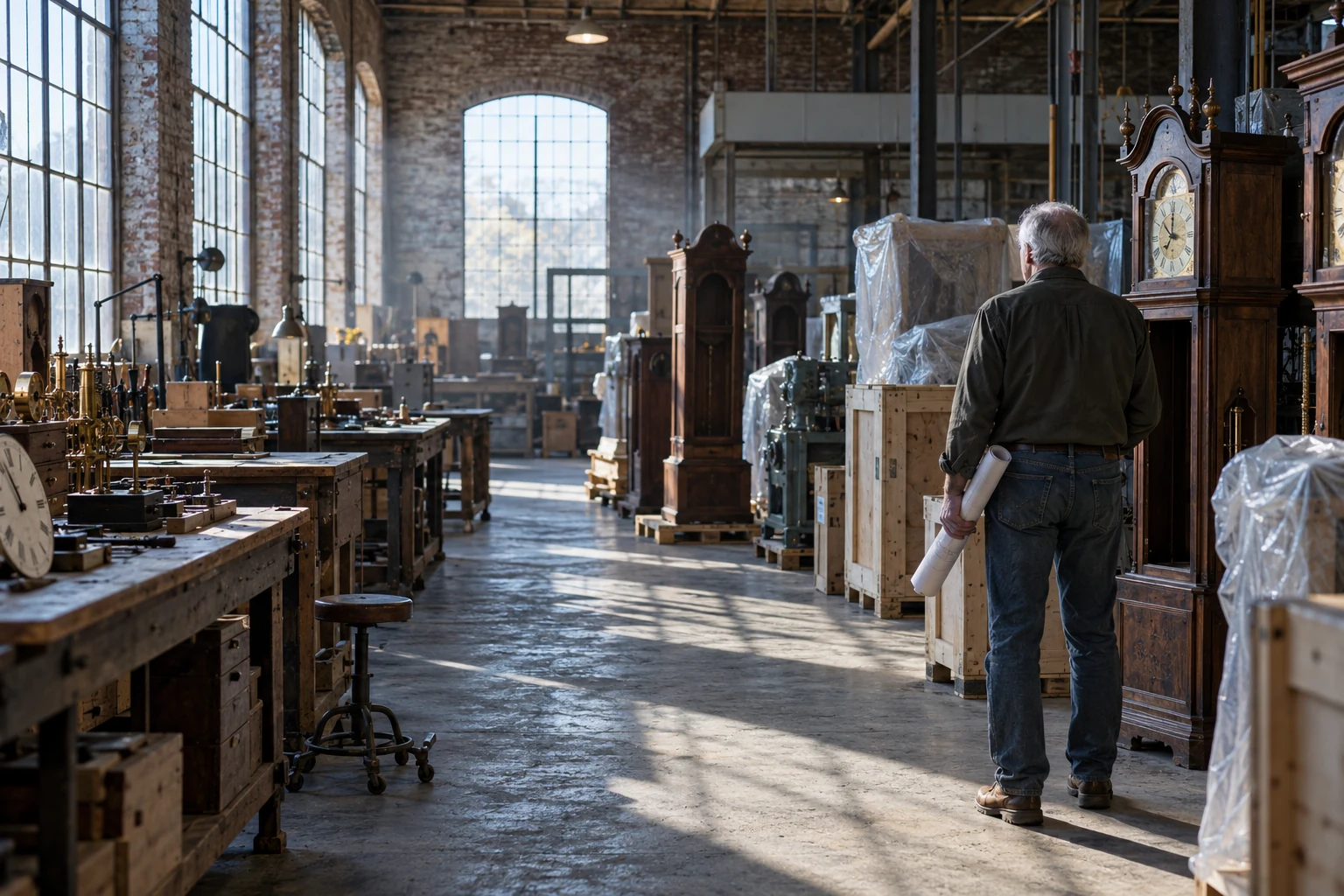
A Designer Without His Factory
Nelson Vandermeer is 62 and voted Republican for decades. In Zeeland, Michigan, he designed products for Howard Miller, the grandfather-clock company founded in 1926. When production ended, Vandermeer and nearly two hundred colleagues lost their jobs. He told the Associated Press that tariffs on imported components also contributed to his job loss—the same policy presented as a way to bring work back to American factories.
The case matters now because it contains three stories that statistics tend to combine. The clock factory closed; new investors bought and relaunched the brand; the large Zeeland plant went to Coastal Container, which plans to use it for assembly, warehousing and packaging. The name can survive and the building can fill up again, but that does not bring Vandermeer's trade back.
The Simple Promise of Tariffs
A tariff raises the price of goods arriving from abroad. The political idea is to make domestic production more attractive, encouraging companies and investors to open local lines. But a factory does not buy only domestic steel and sell an entirely domestic product. Howard Miller imported glass and other components; when those inputs cost more, the company must raise prices, accept a smaller margin, change supplier or give up part of its production.
AP reconstructs a chain more complicated than a slogan. Howard Miller was already struggling as demand for large clocks and furniture declined; it had tried to broaden its catalogue with bar carts, cabinets and consoles. Tariffs, inflation and a weak housing market put further pressure on a fragile business. Saying that one policy alone closed the company would be too simple. Saying tariffs automatically protected those jobs would be equally false.
The same tension appears in Pennsylvania. Lower production at a Post Holdings pet-food plant led to voluntary departures and fewer orders for can maker Trivium Packaging. Heather Kingston, a former Post worker whose husband is still at the plant, told AP that she did not see many manufacturing jobs arriving in the area. Trade protection travels through a supply chain: it can benefit the supplier of one material and hurt the company that must buy it.
National Numbers Do Not Describe the Same Loss
The American picture is not a uniform manufacturing recession. The Bureau of Labor Statistics estimated that the sector added 9,000 jobs in September 2026 and stood 72,000 jobs above its December 2025 low. Plastics, rubber and machinery recorded gains. In the same report, total employment rose by only 29,000 and revisions cut the combined July and August estimate by 60,000.
These data support two statements at once: manufacturing employment has recovered from its recent low, and individual communities have lost factories, shifts and incomes. A national balance does not preserve the product-design work of a century-old company. It does not say whether a new job is ten kilometres away or in another state, whether it pays the same or requires different skills.
Time matters too. The White House argues that today's industrial construction will create jobs when plants come online. That is a forecast, not a result Vandermeer can already see. Someone who loses a pay cheque cannot wait for a future average: they must find work, draw on savings, move house or accept a different role before the promised capacity becomes operational.
The Plant Changes Product
In July, WGVU reported on the second life of the Howard Miller building. Coastal Container bought the roughly twenty-acre site for secondary operations, assembly, warehousing and its packaging-supply division. The company linked the purchase to future room for growth. At its nearby Holland plant it is installing high-speed automated machinery; a $25 million expansion completed in 2022 added more than sixty jobs and brought the workforce to about 180.
That is good news for a property that might have remained empty. It does not prove that the nearly two hundred laid-off workers have been reabsorbed. A department making wooden cases, mechanisms and furniture uses different materials, suppliers and skills from a corrugated-cardboard line. Even when the new owner hires, the match is not automatic: training, selection and time are required, potentially leaving behind people close to retirement or unable to relocate.
Automation makes the comparison even less linear. Coastal describes machinery designed to improve production, quality and service. It can make the business competitive and therefore protect work that might otherwise not exist. It can also increase output without recreating the same number of roles. The useful question is not whether the machine steals a job, but which tasks emerge, what wages the company offers and how many former workers can actually enter.
Brand, Building and Skills
The relaunch of the Howard Miller brand adds another layer. A group of West Michigan investors bought it in 2026 and said they intended to keep its headquarters in Zeeland. The commercial value of the name, designs and sales network can continue after machinery and production have been liquidated. That makes this story different from a final closure, but also harder to classify.
When people say a factory has “returned,” they should ask what came back. If the brand returns, customers and intellectual property survive. If the building returns to use, the area avoids a vacancy and may attract investment. If the people return, part of their income, experience and professional identity is preserved. These outcomes are connected, not equivalent.
For a government, the easiest measure is the number of construction sites or plants. For a worker, the commute, shift, health insurance, wage and ability to use existing skills matter. A credible industrial policy should track both scales: productive capacity and the actual movement of people from one company to another.
The Missing Measure
Zeeland does not prove that every tariff destroys jobs or that every industrial reuse is inadequate. It shows where to look for evidence. In the coming months, the important facts will be how many people Coastal employs at the new site, which skills it seeks and how many come from the closed operations. For Howard Miller, the actual location of production, its suppliers and the roles retained by the new owner will matter.
Until those data exist, two narratives can coexist: one points to recovering national manufacturing employment, while the other shows families that lost an income. The difference is resolved by following people, not by choosing a preferred slogan. A factory building lit again is an important signal. For Vandermeer, however, the transformation will be complete only when someone can say what work replaced his.