 Italiano
 English
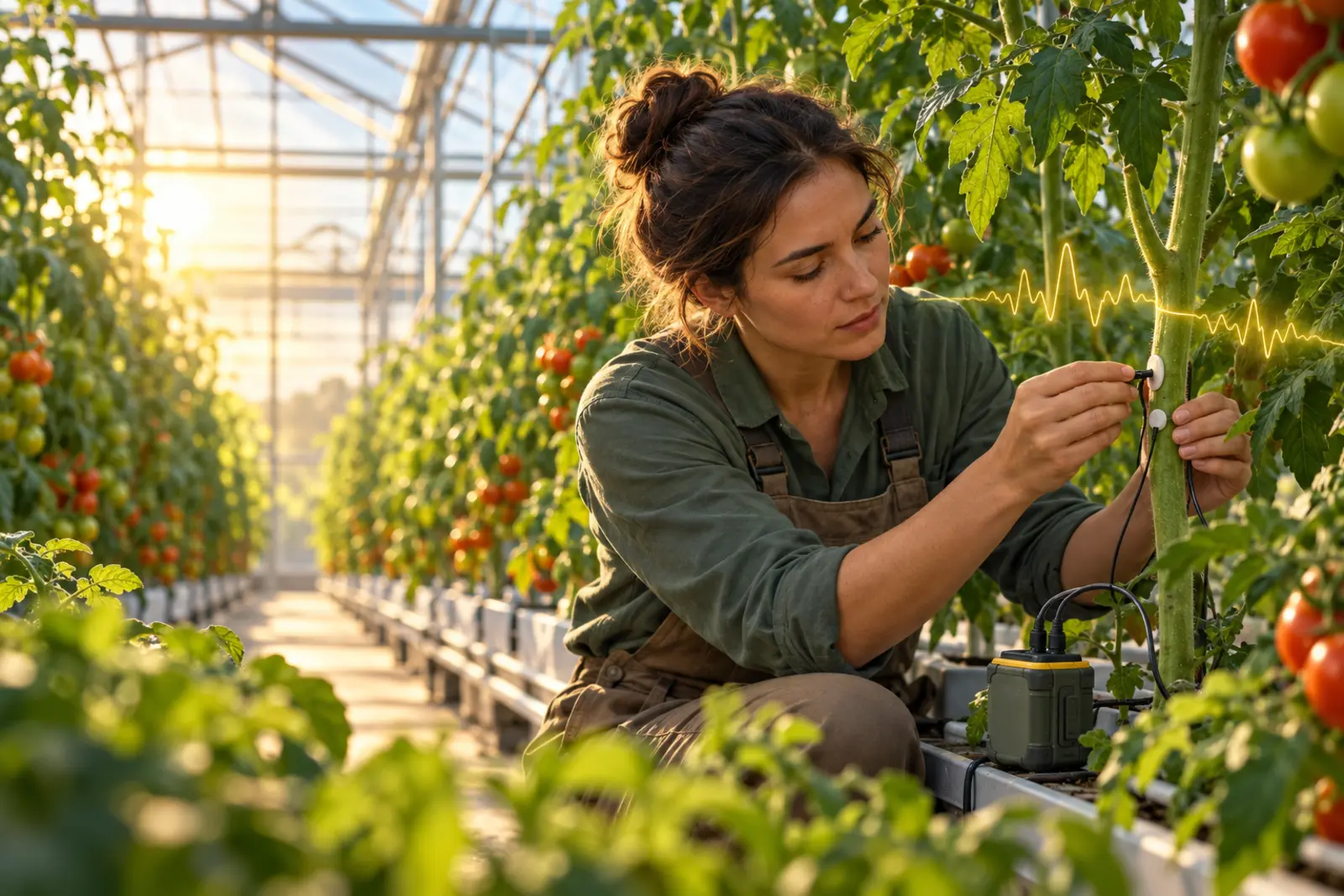
The signal arrives before the leaf droops
When a plant shows drooping leaves, spots or slower growth, the grower sees a problem that has already begun. Electric Plant wants to move that discovery earlier. The startup attaches small electrodes to the stem and measures electrical changes traveling through plant tissue. Its model, called Bombadil, looks for patterns associated with thirst, temperature, injury and other changes. The goal is to alert growers before stress becomes visible and before water, fertilizer or treatments are distributed without knowing whether they are truly needed.
The company emerged from stealth on October 20 with $11.2 million raised. It says it has recorded signals in laboratories, greenhouses, commercial orchards and forests. The scientific paper published by the authors describes more than four million hours from over one hundred species and ten environments. TechCrunch reports a larger base that has grown to roughly seven million hours and 125 species. The figures are not interchangeable: the first dataset is documented in the technical paper, while the second reflects the company archive claimed at launch.
What an electrode actually measures
Plants do not speak in the human sense. Their cells move ions across membranes and generate changes in electrical potential. These signals take part in responses to light, temperature, damage and water availability. Measuring them has long been possible; the difficult step is determining which changes matter, separating them from noise and recognizing the same phenomenon across different species and conditions.
Bombadil approaches the problem as a foundation model: it is first trained without labels to find regularities in the traces, then adapted to specific tasks using classified examples. The authors report that the learned representation can transfer across species and environments and help recognize biological events. This is a research result, not a universal agronomic guarantee. A greenhouse tomato, a field-grown vine and a forest tree have different physiology, microclimates and disturbances; cables, electrode contact and maintenance add further variables.
The sensor does not automatically deliver a diagnosis. It produces a stream that the model interprets and that must ultimately become a choice: irrigate a row, inspect for disease, change the temperature, or do nothing. Commercial value is determined in this translation. An early warning matters only if it distinguishes different causes well enough and if the cost of errors remains below the cost of the problems avoided.
From the camera to the plant itself
Precision agriculture already observes fields and greenhouses with satellites, drones, cameras, weather stations and soil sensors. These tools infer crop condition from its surroundings or from what appears on the leaves. Electric Plant proposes a different source: the signal produced by the organism itself. It does not automatically replace existing measurements. It can become an additional layer, especially useful when a physiological change precedes a visible symptom.
For a farm, the problem is not collecting another chart. It needs to know whether the system reduces a specific cost. A reliable warning could focus irrigation where plants show stress, prompt earlier inspection of one part of an orchard, or avoid treatment across an entire field. The company names agriculture, forestry and research as initial markets. But it has not published pricing, an independent crop comparison or a false-alarm rate sufficient to calculate returns per hectare.
Installation matters too. A sensor on a stem must withstand growth, rain, dust, machinery and manual work. A few sample plants may describe a plot; thousands of sensors increase coverage but also cost. Customers will need to know how many measurements are required, how long the device lasts, and who checks that a loose contact is not mistaken for a biological message.
The product is a decision, not the model
Electric Plant grew out of the meeting between founder Justin Mast and neuroscientist Lee von Kraus. The company says it built both the hardware and the model because the required data did not exist at sufficient scale. That choice creates a barrier for competitors, but also forces the company to master two businesses: producing robust sensors and maintaining a system that can adapt to new crops.
The $11.2 million funding round finances the move from research to early applications. Potential markets include sensor makers, agronomic advisers, irrigation platforms and agricultural insurers, but open sources do not yet show large-scale contracts. The decisive question is not whether the model recognizes patterns in laboratory data. It is whether a grower receives guidance clear enough to change an action and can verify after the season that the choice protected yield, water or labor.
Responsibility does not disappear behind the algorithm. If the system advises against irrigation and the crop suffers, or flags a disease that leads to unnecessary treatment, growers need logs, understandable thresholds and human oversight. The startup will have to show not only average accuracy but performance by species, climate and type of stress. A model trained on many plants may be general; agriculture remains local.
The test will come at the end of the season
Bombadil reveals a broader opportunity: use biological signals as an operational input instead of waiting for an organism to show damage. In the field, this means trying to intervene earlier and more selectively. The same ambition subjects the system to a demanding test. Similar plants can react differently; water stress can overlap with heat; a warning that is correct today may not transfer to the variety grown tomorrow.
The next important figure will not be another funding total or the number of recorded hours. It will be a comparison in commercial crops: how much water or how many interventions were avoided, at what yield, how many alerts were useful, and what each decision cost. If those numbers hold up, the sensor will not sell the romantic idea of listening to plants. It will sell time: the hours or days gained between the first sign of stress and the moment the problem becomes visible.