 Italiano
 English

The command comes from the muscle
Guiding a prosthetic limb could involve tracking two tiny magnets implanted in a muscle. On October 29, an MIT team presented a new interface tested in three people with below-knee amputations. The result concerns the ability to turn residual movements into a precise command. It does not yet show that participants walk better: in the experiment, they moved a cursor on a screen without wearing a prosthesis.
The distinction matters because an artificial leg needs reliable instructions as well as motors and joints. The project tackles that step: understanding what the muscle is doing and providing robotic control with a usable signal. For someone who relies on a prosthesis, the interesting promise is movement that takes less effort to command. But that is an aim of the work, not an everyday benefit already measured.
The authors include Christopher Shallal, Cameron Taylor and Hugh Herr. Their choice shifts attention from the electricity produced by a muscle to its mechanics: how much its length changes and how quickly. It is called magnetomicrometry. Behind the difficult name is a fairly intuitive measurement: observing from outside how the distance between small markers inserted into the tissue changes.
A sensor outside, small markers inside
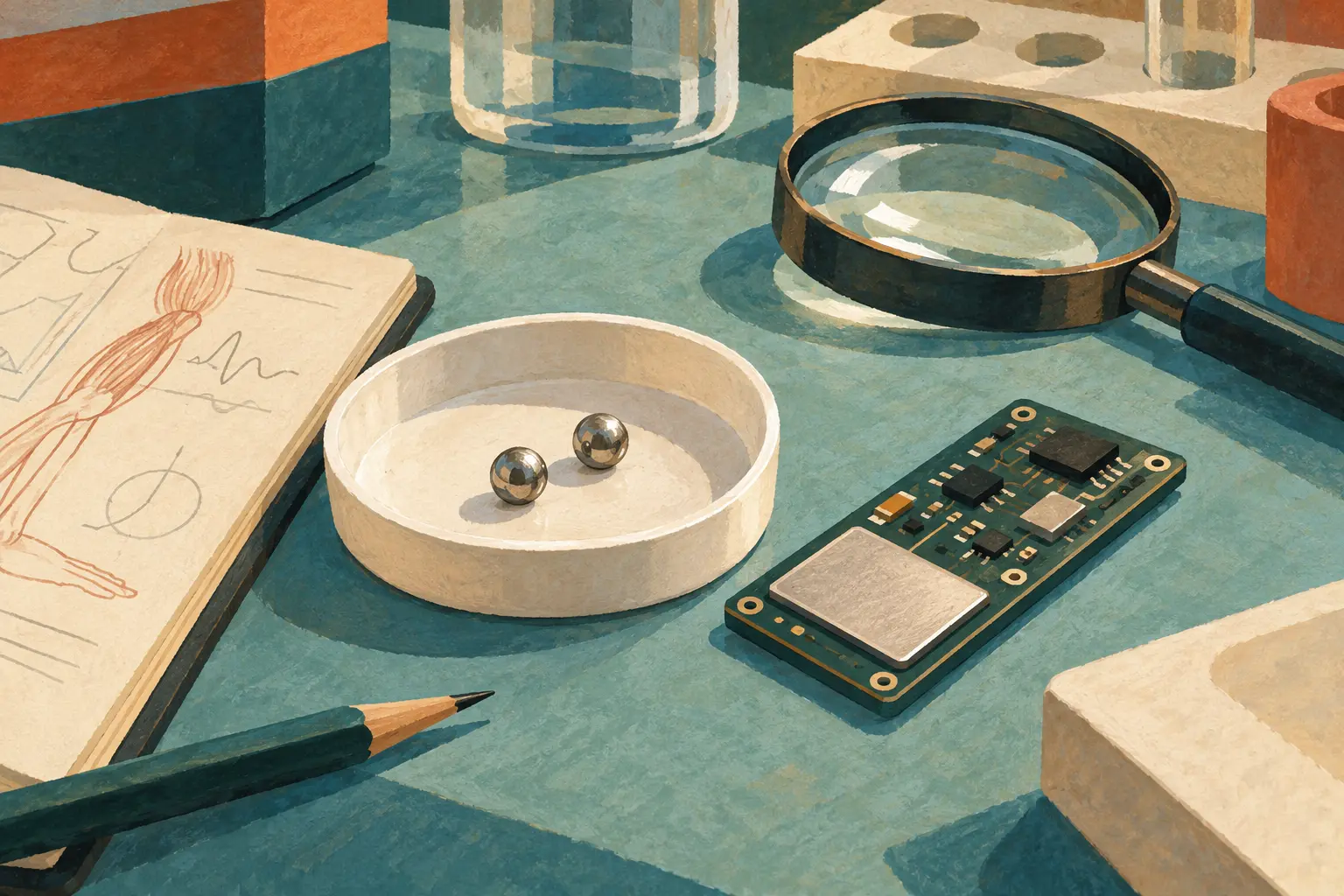
The abstract published in Nature Sensors describes passive magnetic beads three millimetres across and an array of magnetometers placed on the skin. The external electronics track the magnets through the tissue, reconstructing muscle dynamics in real time. The authors report sub-millimetre resolution and readings at depths of up to six centimetres. These are features of the experimental system, not specifications for a product available to buy.
The comparison also involved electromyography, which reads the electrical activation of muscles, using both surface and implanted electrodes. According to the abstract, magnetic estimation matched or outperformed these alternatives across most of the outcomes assessed. That does not mean it won on every measure or can already replace all other interfaces. The result still applies to the three participants studied.
The design trade-off is clear: the body contains passive markers, while the reading remains external. Having no wires coming out of the muscle does not mean having no surgery, and having no large electronic implant does not mean having no equipment to wear. Simply calling it an invisible sensor would erase the very choice a person would need to consider: what to put inside the body, in exchange for what demonstrable advantage.
Three people, one particular condition

All participants had a surgical interface called AMI: muscle pairs are reconnected so they continue to interact within the residual limb. The specialist magazine The O&P EDGE specifies that magnets had been inserted into up to four muscles involved in ankle movements. The same account makes clear that the task was to reach targets with a cursor, not to support body weight on a robotic foot.
This is an important condition when interpreting the result. A successful test in this group does not automatically provide an answer for people with different surgery, other muscle conditions or different needs. Before discussing wider access, we would need to know whom the interface works for, what requirements it has and how it behaves over time. A small study can show a possibility; it does not yet establish a solution for everyone.
Virtual control has a specific use, too: it allows different signals to be compared in a common task. But a screen does not reproduce all the consequences of an error during a step. Two questions must therefore remain separate when reading the result: how well the system recognises a movement, and how well a person can use a prosthesis in everyday life. The first can prepare the way for the second, not replace it.
The market starts after the demonstration

MIT reports that a larger study is under way to assess control of real prosthetic limbs using the beads. That is the step to watch. The sources consulted provide no price, sale date or verified clinical availability for this new interface. It would be wrong to present it as a service people can already book, or attribute savings or safety results to it that have not been measured.
For a business seeking to take it beyond the laboratory, the challenge would not end with the sensor. The measurement would need to become part of a usable whole: an interface, prosthesis control and support for the person. From an editorial perspective, this is where a business model would need to be examined: who covers the initial cost, and who is responsible for maintenance. We do not currently have evidence to answer those questions, and inventing a market would be premature.
For the person using the device, the useful comparison would instead be with their actual alternative. Better control would need to offer an advantage important enough to justify the implant and any constraints. A technology appearing less invasive than another does not automatically make it preferable. The decision would make sense only by considering performance, burdens and the person's priorities together, not by ranking solutions from newest to oldest.
The next result needs to leave the screen
This story deserves attention because of where it intervenes: the connection between a body and a machine that must respond to it. It does not try to make the prosthesis more spectacular, but to improve the information used to control it. This is a different direction from simply adding power or features: a machine's capability is valuable insofar as the person can actually use it.
The next test will need to establish whether the control advantage survives when a real artificial limb is involved. For the reader, the signal to look for in future announcements is not another image of a bionic leg, but a comparison specifying who was studied, what task they performed and what the alternative was. Today, we know that three people guided a cursor with this interface. For now, that is where the verified step ends.