 Italiano
 English
The component before the promise
To reach commercial fusion, Helion wants to build better electronic switches. On October 22, the US company announced a letter of intent with the Department of Commerce for up to $175 million in support for power semiconductor research. These components must control large flows of electricity repeatedly and with low losses. The funding is not yet a definitive agreement and does not demonstrate that a power plant is already generating electricity for customers. It does, however, reveal a concrete problem: before the promised energy can arrive, reliable parts, factories and people able to assemble them are needed.
The public funding would be accompanied by $50 million in private investment. Helion earmarks more than $100 million for semiconductor research and advanced packaging in Everett, Washington; around $80 million would go to tooling, design and manufacturing processes with a partner in Vermont. The project therefore concerns industrial capabilities to be developed, not the purchase of a ready-made power plant.
Creating plasma, recovering electricity
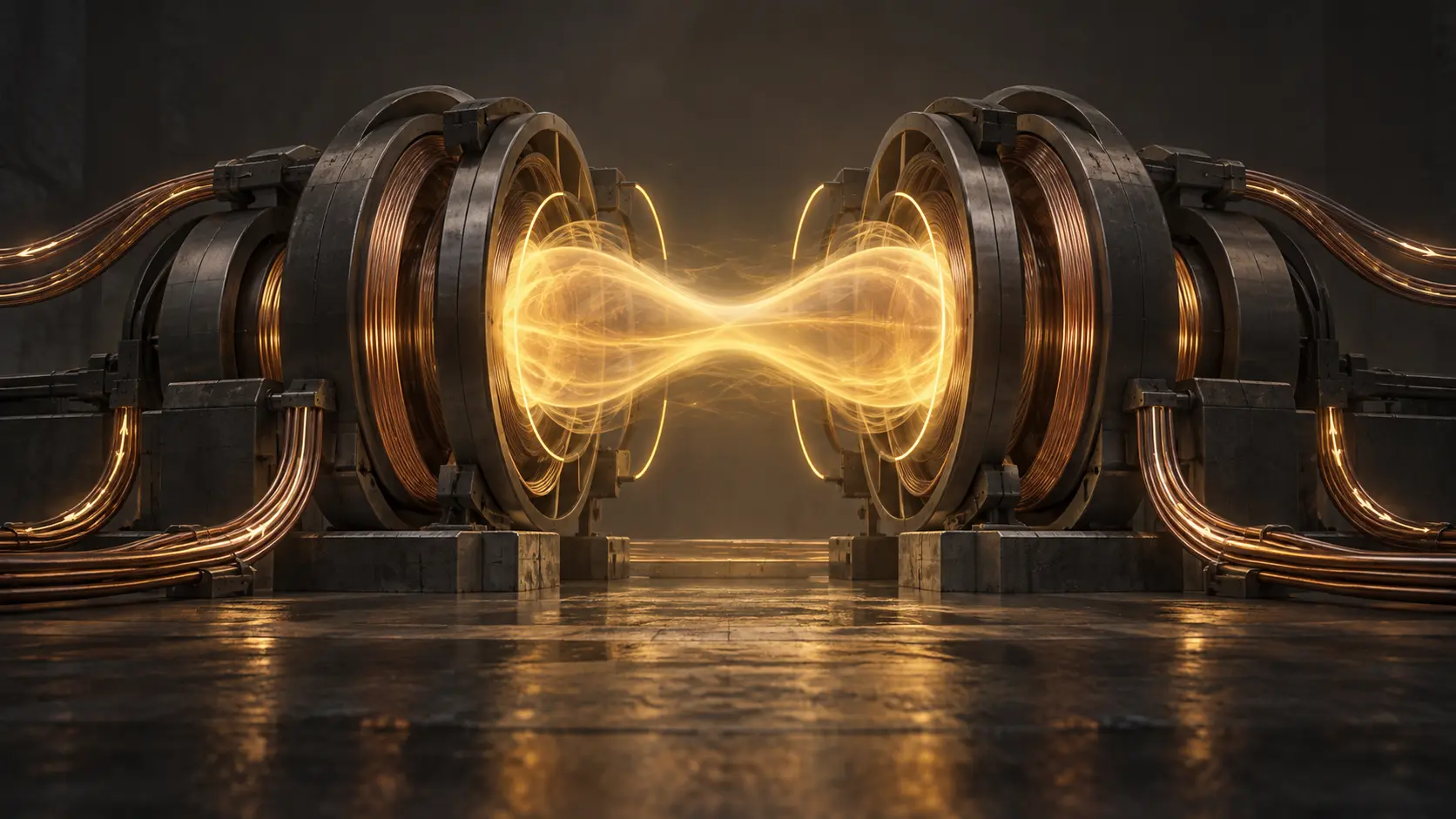
Helion's approach starts with a gas brought into a plasma state, in which charged particles respond to magnetic fields. In the configuration described by the company, two plasmas are accelerated from opposite ends, merged and compressed at the center of the machine. Fusion requires extreme conditions; the design seeks to achieve them through repeated pulses rather than continuously maintaining the same state.
When the plasma expands against the machine's magnetic field, it can transfer energy to the electrical circuit through induction. Helion thus designs for direct electricity recovery, without necessarily going from heat to a steam turbine. This is the system's principle, not a certification of commercial efficiency. The balance must include the energy used to prepare each pulse and run the whole system.
In this architecture, electronics are not an accessory. They must control the pulses and recover energy without wasting too much of it. A good result in the plasma and good performance from the whole plant are two different tests. The company's technical description explains its chosen approach; on its own, it cannot establish the cost of a kilowatt-hour sold.
A factory that must last longer than an experiment
In the GeekWire interview, CEO David Kirtley links the program to semiconductor engineers, materials scientists, technicians and assemblers. The work in Everett is expected to create more than a hundred jobs: this is a project forecast, not a count of new hires already completed. The work would also include modules, integrating several devices into groups that can be used in the machine.
GeekWire identifies GlobalFoundries as the partner for the research planned in Vermont. It also reports that Helion already has semiconductors, mainly from overseas suppliers, for the Orion project. The new initiative therefore does not mean construction is on hold while every component is invented. It adds a development track that could supply later devices as construction proceeds.
The distinction matters to anyone who has worked on an industrial machine: making it work once is not the same as operating it every day. Service life, replacing parts and ease of cooling affect a component's usefulness. For Helion these are stated research goals; the open sources do not yet provide operating results demonstrating savings in use.
Public money buys research, not a lower electricity bill
The proposal is part of four letters of intent announced by the Department of Commerce for a combined maximum of $389 million. The document published by NIST links the program to electronics that control, convert and deliver power. In return for the final awards, the Department would receive minority, non-controlling, non-voting stakes in the companies involved.
Not all of it concerns Helion. The plan includes up to $85 million for Commonwealth Fusion Systems, $73 million for Vertical Semiconductor and $56 million for Sibelco. Projects range from electronics for plasma heating to devices for advanced computing and quartz purification. The common thread is the supply chain: even a new technology depends on less visible materials and processes.
Data Center Dynamics describes the overlap between demand for computing and energy research. The shared need to manage high power levels draws attention to components, conversion and thermal losses. This does not mean a component developed for fusion can automatically be transferred to any application: specifications, testing and customers still have to be secured. Any industrial value must be distinguished from the ultimate success of each reactor.
There is a customer, but delivery still lies ahead
For Orion, Helion identifies a specific customer: Microsoft. The project page recalls the power purchase agreement signed in 2023, with a plant designed to supply at least 50 megawatts and begin initial operations in 2028. The company documents the start of site work in 2025 and construction of the generator building in 2026. These steps show a construction project; they are not electricity already delivered.
For readers, the signal to watch is not simply the next fundraising figure. Results are needed on net energy, repeated operation and the costs of the complete plant. For people working in the supply chain, the questions are already practical: which components will be made, to what performance specifications, and what skills will be needed to test them? A promise of energy becomes an economic activity when someone can build, maintain and charge for a reliable service.
The next verifiable step in this announcement is closer and less spectacular than a new source of electricity: turning the letter of intent into a definitive agreement, then into production capacity and tested devices. These documented results will provide a basis for assessing the program's progress. The power plant will have to pass its own test. Before that, the switches will have to pass theirs.