 Italiano
 English
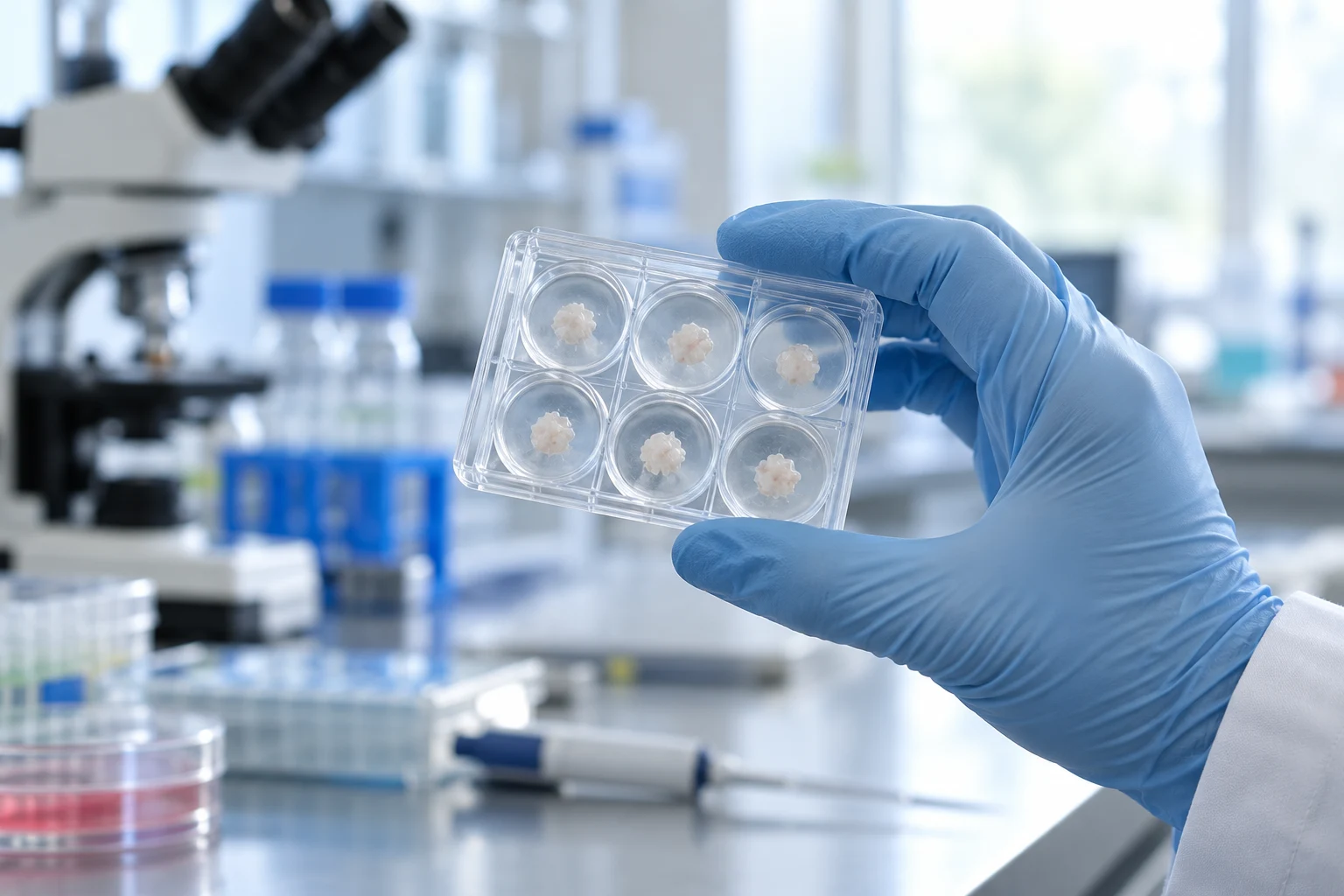
A piece of intestine, before the patient
Before testing a medicine in people, researchers can observe its effects on small human intestinal tissues grown in a laboratory. That is the work of Intero Biosystems, born from research at the University of Michigan: it produces organoids, three-dimensional structures that reproduce certain characteristics of the intestine. Its product is called GastroScreen. It does not treat anyone and is not an organ for transplantation: it helps researchers discover earlier whether a substance damages tissue or produces the intended effect.
The problem is tangible. A compound that looks promising in the laboratory may behave differently in the human body. Animals and traditional cell cultures provide valuable information, but each model represents only part of reality. Adding more complex human tissues could improve the selection of candidates. The crucial question is how reliable their responses are: a visually convincing model must also become a useful measurement for making decisions.
How the model is made
The platform starts with induced pluripotent stem cells: adult cells returned to a state from which they can develop into different cell types. Under controlled culture conditions, they are guided to form intestinal tissues. The result is not a complete intestine shrunk to a smaller size, but a biological system that reproduces particular components and functions.
Intero says it includes the intestinal lining, supporting cells, smooth muscle, neurons and blood vessel cells. It also describes contractions resembling those that move contents through the intestine. These are platform characteristics presented by the manufacturer: they do not mean the model digests a meal or reproduces every reaction of a person.
The difference from a layer of cells lies in the interactions. A substance can alter the intestinal barrier, damage a cell population or modify tissue movement. Observing several components in the same experiment allows researchers to ask different questions. It does not remove the need to choose exactly what to measure and which controls to use.
What customers do with these tissues
A laboratory receives the organoids, maintains them under the specified conditions and exposes them to the substance being studied. Intero offers measurements based on imaging, gene and protein expression, barrier integrity and functional responses. Researchers compare treated samples with controls, looking for differences attributable to the substance rather than normal variation in the culture.
Co-founder Madeline Eiken described an example to Santa Clara Magazine: induce a condition resembling intestinal fibrosis in the tissue, introduce a drug and observe whether disease-associated characteristics change. Another application is studying cell damage caused by compounds. These are preclinical experiments: a favourable response does not establish that a treatment will work in patients.
For someone developing a medicine, a negative result can also have value. If a reliable test flags a problem early, the team can reassess the compound before committing further resources. That is the model's economic proposition: improving a decision during research. We do not, however, have sufficient data to quantify a standard saving for every drug.
From research to a product
Intero was founded in 2024 as a spin-off from Jason Spence's laboratory at the University of Michigan. In June 2025 it announced two million dollars in initial funding, intended partly to expand production and better assess the platform's predictive ability. Commercial development requires both: producing tissues and demonstrating that they help researchers make choices.
Selling a biological model differs from delivering an identical instrument to each customer. Samples, maturation times and experimental conditions must be comparable. A laboratory needs to distinguish a compound's effects from differences between batches. If the culture method changes, researchers must understand how much this affects previous results.
For customers, the assessment therefore concerns the entire workflow: staff preparation, equipment, protocols and data interpretation. A more sophisticated model is not automatically the best choice for every question. If a simple test already provides reliable answers, the added complexity must justify its cost. Value emerges when it makes something measurable that previously escaped observation.
Before adopting it, a laboratory manager should ask which reference substances were used, what errors the test made and under what conditions results can be repeated. These are operational questions, not details to leave to a brochure. If two laboratories reach opposite conclusions about the same compound, they need to establish whether the tissue, dose or procedure explains the difference. A contract can buy samples and support; confidence in the method is built through verifiable comparisons. This is where a promising discovery can become an everyday tool, or remain confined to specialist experiments.
Rules are opening up; validation remains essential
In April 2025, the US FDA announced a pathway to reduce, refine or potentially replace certain animal tests in drug development. Tools under consideration include organoids, systems reproducing organ functions and computational models. This opens the door to data obtained through alternative methods; it is not a blanket approval of every product carrying that label.
Assessing usefulness requires defining the precise intended application. A system capable of detecting intestinal barrier damage does not thereby establish a medicine's safety for the heart, liver and immune system. Variation between people matters too: one sample represents a particular biology, while people taking the drug will have different ages, conditions and treatments.
The most interesting evidence will therefore come from comparing the model's predictions with effects already known in humans, followed by tests on new compounds. Reproducible results and clearly stated limits are needed. For now, GastroScreen offers a more detailed way to investigate intestinal tissue. Benefits for future patients will depend on how well its answers improve decisions before a substance reaches clinical testing.