 Italiano
 English
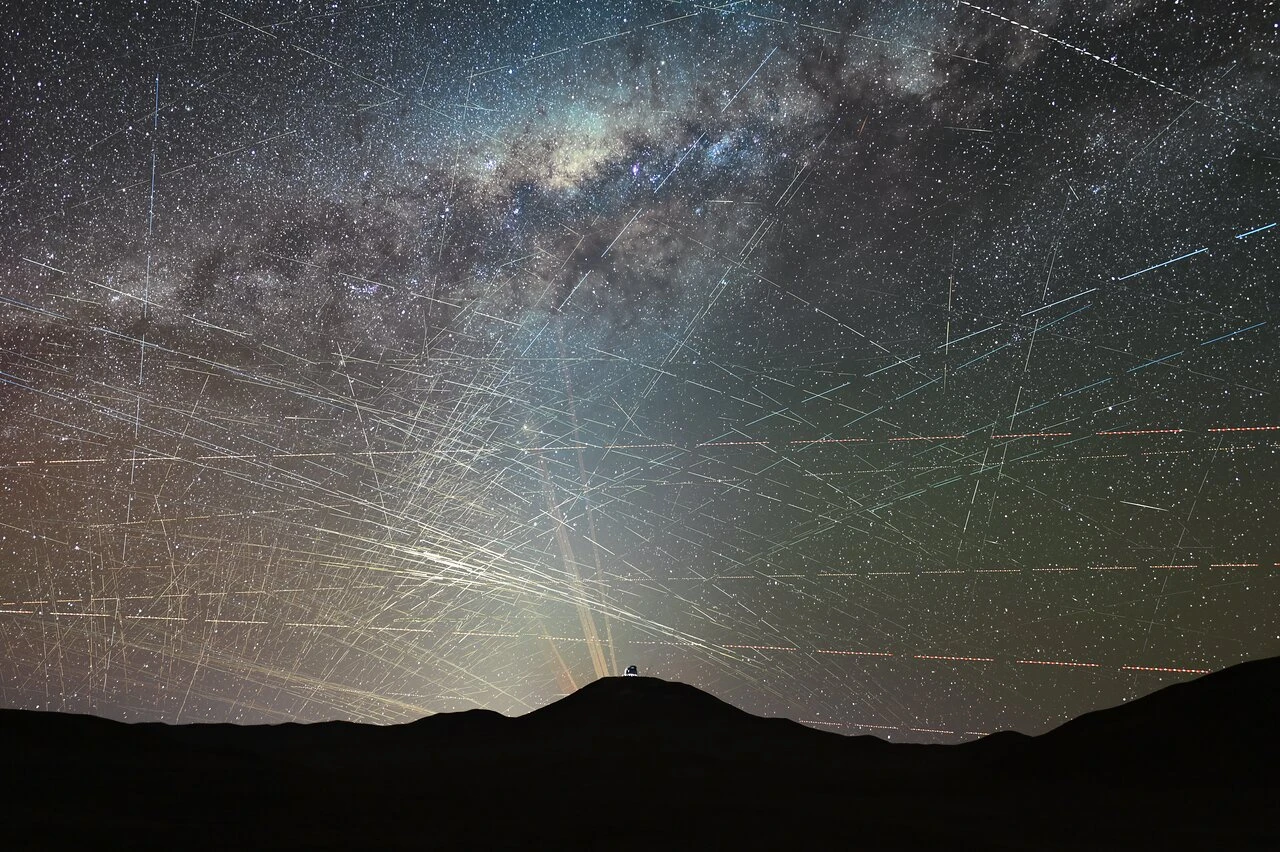
An hour above the desert
The lines cross the sky in every direction. Below, on Cerro Armazones, the dome of the Extremely Large Telescope under construction is visible. The photograph released by ESO does not portray a single, motionless night: it combines an hour of footage recorded on 15 October 2025, about two hours after sunset, in the Atacama Desert. Some trails belong to aircraft, recognisable by their blinking lights; most are produced by satellites. It is a record of traffic, not a photograph of how the eye sees the sky at a single instant.
That distinction makes the image more interesting. The sky does not have to look like an illuminated city to create a problem for people collecting faint light to study the Universe. A brief passage can leave a trail during a long observation. The frontier is not only how much space we can occupy up there. It is what remains observable from down here, as infrastructure designed to offer new services crosses other people’s field of work.
The problem enters governments’ decisions
On 28 September, Space.com reported on the Outer Space Institute’s initiative to ask the United Nations to seek an advisory opinion from the International Court of Justice on protecting the sky and near-Earth space. Aaron Boley, an astronomer at the University of British Columbia and co-director of the institute, links this approach to the difficulties of international negotiations. The campaign dates back to 2023: what is new is the urgency attributed to new proposals for orbital infrastructure.
The status of the story must remain clear: scientists are promoting a request, not announcing a new ban already in force. According to the report, a possible opinion would have diplomatic and interpretative value, without being equivalent to an enforceable order setting the number of satellites a company could launch. It is not an immediate solution. It is an attempt to bring a widespread consequence into the place where responsibilities are defined.
The question that emerges is political before it is technical: who must consider a service’s effects when they also fall on people who have not purchased it? A connection has an identifiable customer. The ability to observe a largely undisturbed sky has numerous beneficiaries, often without a contract to represent them.
Two skies to protect
The paper from the IAU centre for protecting the dark and quiet sky, published on arXiv and updated in February 2025, distinguishes two types of interference. Satellites reflect sunlight towards optical telescopes; their radio emissions can disturb observatories working with radio signals. Dark and quiet therefore describe different conditions, both needed for part of astronomical research.
The authors also recognise the value of constellations for communications and Earth observation. The stakes cannot be reduced to a choice between progress and conservation. The same environment hosts useful services and scientific activities that need conditions incompatible with some forms of interference. The paper argues that protection is insufficient and calls on states to act: this is a scientific community position, not a description of worldwide regulation that has already been completed.
The global nature of orbits complicates a local response. Moving an observatory away from city lights can help with illumination on the ground, but it does not eliminate infrastructure passing above that location. The authors also highlight planetary defence, knowledge and cultural heritage. Astronomy here extends beyond academic curiosity and becomes a shared capability to maintain.
Hainaut calculates a possible future
Olivier Hainaut, an ESO astronomer, has simulated the position, motion and brightness of existing and proposed constellations. In its 1 July 2026 release, the observatory reports a study of the consequences of projects totalling more than 1.7 million satellites. That number refers to proposals, not objects already in orbit. It is essential not to turn the scale of an industrial possibility into a picture of the present.
For the simulated large SpaceX constellation, ESO reports losses of up to 28 per cent of the observed field in images taken by the Very Large Telescope two hours into the night, even assuming satellites too faint to be visible to the naked eye. The figure depends on the case studied and its assumptions: it does not mean that every telescope currently loses that share of observation.
The difference between measurement and simulation does not diminish the value of this work. Calculating beforehand is precisely what makes a decision open to discussion before it becomes irreversible. A well-specified prediction allows us to ask which assumptions support it, which changes would reduce interference and what should be tested in practice. A percentage without context, however, risks becoming merely an alarming headline.
Benvenuti seeks a workable compromise

Another route has already entered diplomacy. In the IAU’s 2025 account, twenty states contributed to the discussion of dark and quiet skies at the UN Committee on the Peaceful Uses of Outer Space. Its Scientific and Technical Subcommittee will discuss the subject every year until 2029. This does not prove the problem is solved; it shows that it has become an established topic of debate.
Piero Benvenuti, head of the IAU delegation and director of the centre dedicated to the problem, describes the goal of allowing technological development and scientific discovery to coexist. Recommendations include research into less disruptive materials and designs, coordination and a worldwide database of radio-quiet zones. These are different tools: some change the machine, while others make the territory it crosses easier to understand.
For those following this story, compromise will be credible when it becomes possible to understand who changes what and with which result. Declaring collaboration is not enough. We need conditions that can be checked, observable consequences and participants able to challenge a promise that remains on paper. This is an editorial criterion for assessing future announcements, not certification of solutions already available.
The service absent from a price plan
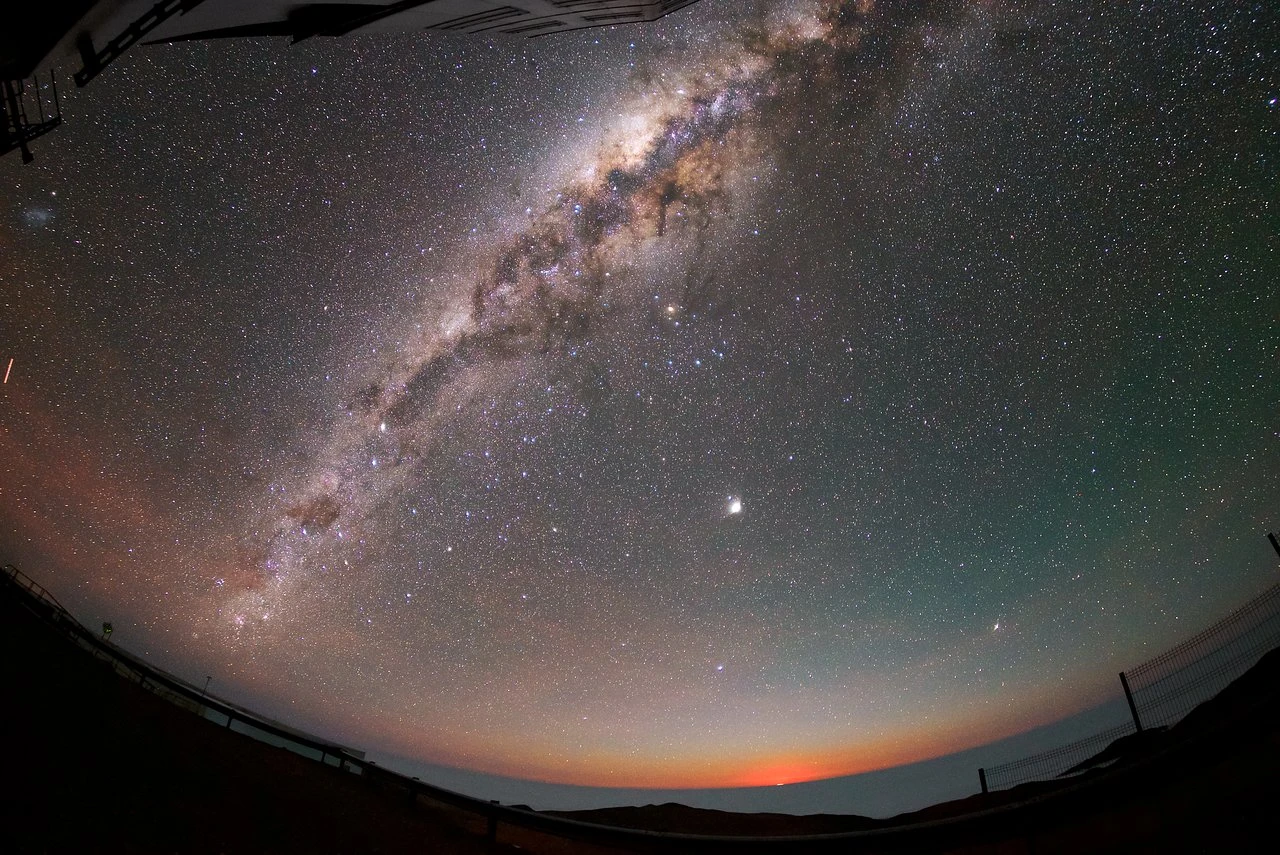
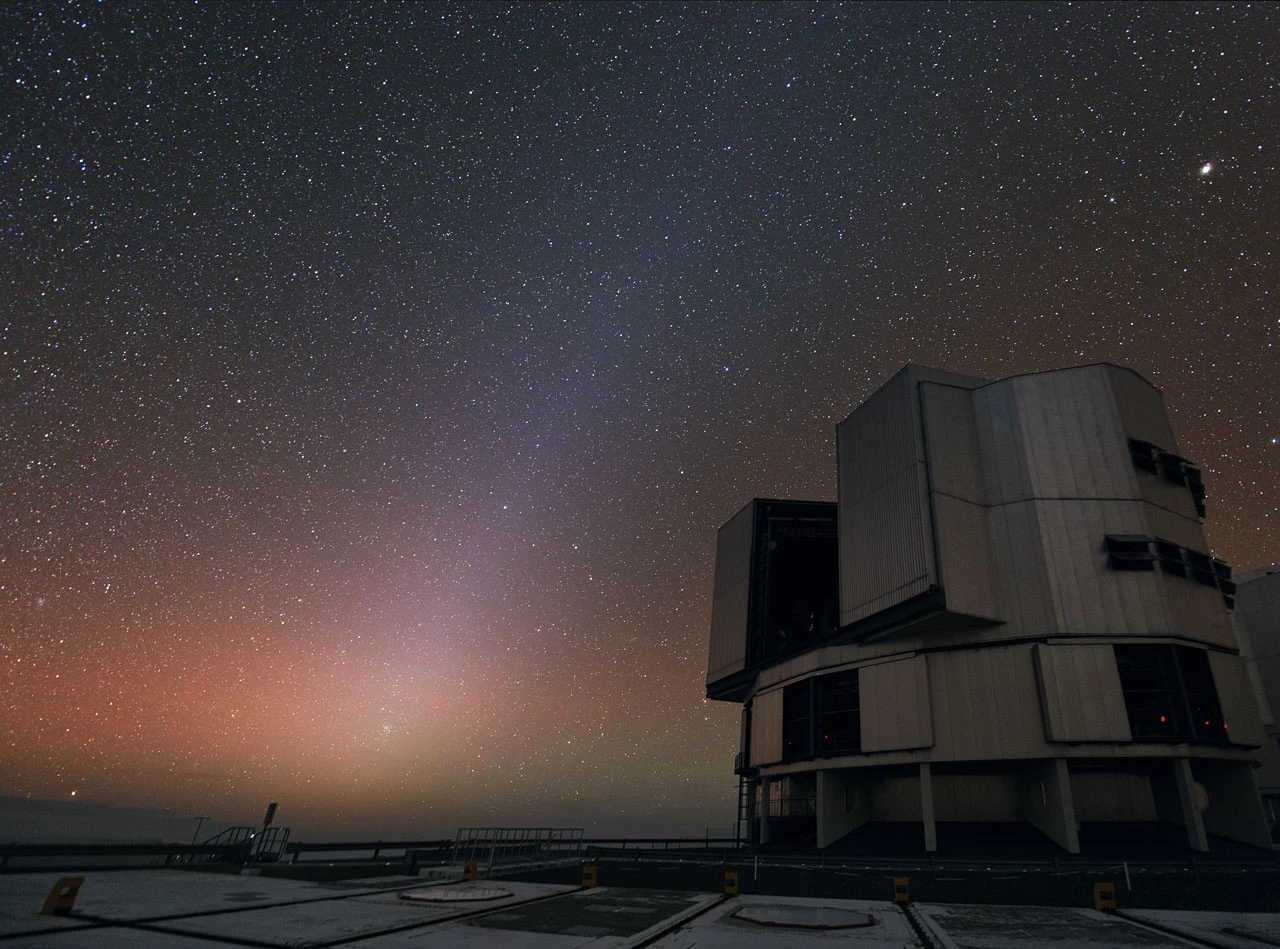
The photographs of Paranal show why the sky is also a workplace. Domes, instruments and landscape belong to infrastructure built to turn weak signals into knowledge. Protecting its conditions does not mean demanding that every other activity stop. It means making visible what a new activity can change for other people.
Our interpretation is that the future of orbits tests a very terrestrial capability: designing a service while also considering those who will experience its effects without being customers. We do not know which legal route will succeed or how many proposed constellations will be built. But we can separate what is documented, what operators envisage and what researchers simulate.
The next step to follow will not merely be a launch. It will be a decision able to show how connectivity and observation can continue together. Stars do not need to disappear for someone to finally be proved right: the useful decision comes earlier, while there is still room to change the design.