 Italiano
 English
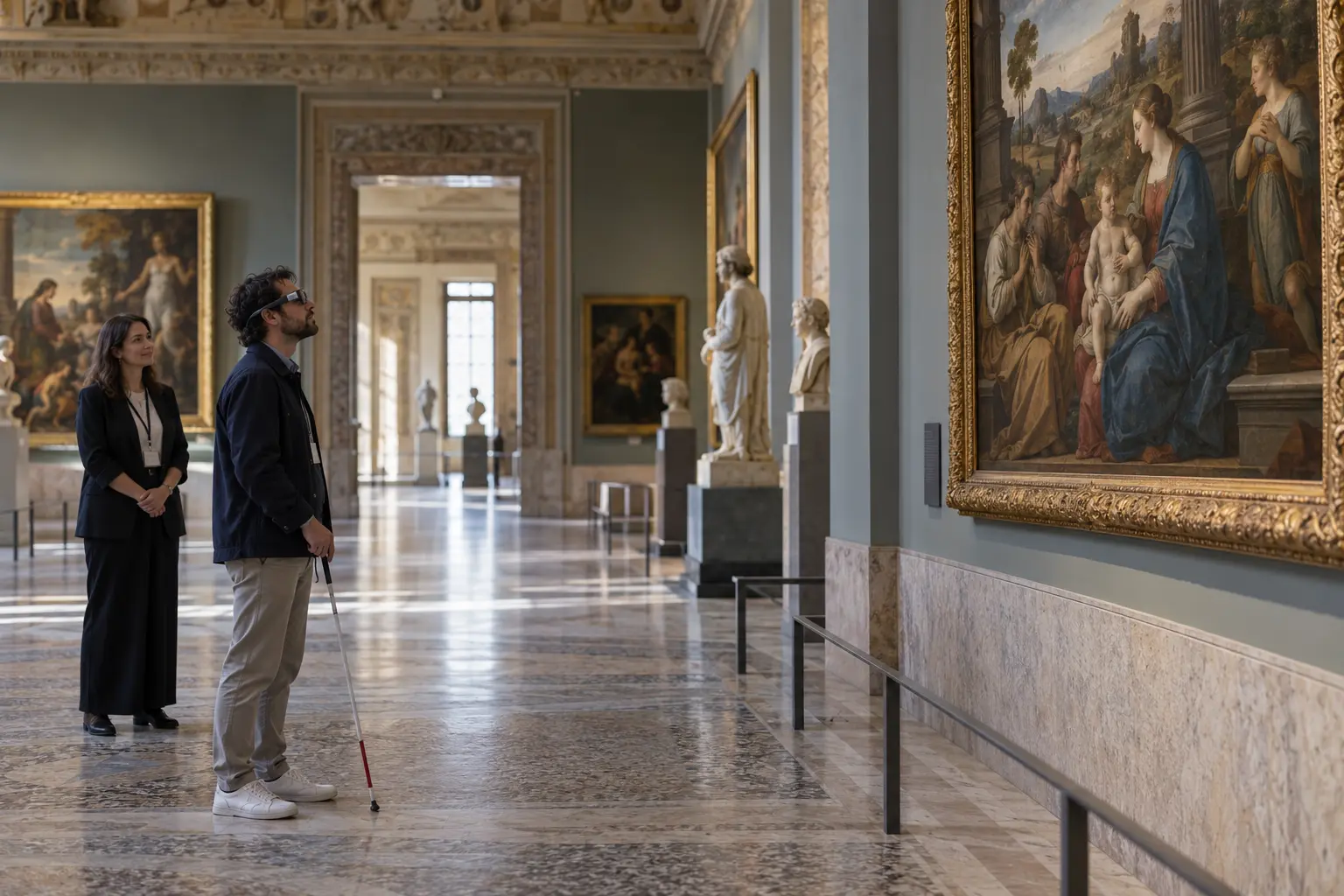
The description starts in the glasses
Since October 13, at Milan’s Pinacoteca di Brera, a blind or low-vision visitor can book a pair of smart glasses, stop before one of eight selected masterpieces and listen to its description through speakers built into the frames. They do not have to hold a phone. The device recognizes the work and retrieves content prepared by the museum; short audio tracks also guide the move from one room to the next. What is new is not that a machine can talk about a painting. It is that a museum is trying to turn that object into a service that can be used during a real visit.
The trial is called “Sensing Art — Discovering Masterpieces Beyond What Meets the Eye” and is promoted by the museum, Meta and EssilorLuxottica together with the National Association for People with Low Vision, the Italian Union of Blind and Visually Impaired People and Milan’s Institute for the Blind Foundation. It is available by reservation from Tuesday to Friday. Its scale is small and explicit: eight works, limited hours and a trial to observe. There are not yet public data on how many people have used it, how many recognition attempts have failed or how much additional autonomy it has produced.
The decisive intelligence was written beforehand
The route does not ask artificial intelligence to improvise the entire visit. It starts with DescriVedendo, the method Brera already uses to translate an artwork’s shapes, composition, details and spatial relationships into words. Three layers of content are available for each painting: a morphological description, a historical and artistic overview, and the artist’s biography. Visitors choose what to hear. The glasses therefore act as an interface: they recognize the context and deliver material prepared by people.
That distinction matters. A generative model can answer questions about the context or surroundings, but the core of the visit does not come from an improvised response. It was designed, checked and linked to the artwork. The most useful innovation is almost invisible: taking the phone out of the visitor’s hands and leaving the cane, orientation and conversation unencumbered. Open-ear speakers also let visitors continue to hear the room and nearby people instead of sealing the experience inside headphones.
Meta says that more than one million people in Italy are blind or have low vision. The company reported that figure at the project’s launch, and it should be read as such. The need does not require a dramatic number to be real: many cultural institutions offer audio guides, accompanied visits or tactile aids, but access often depends on reservations, separate devices and staff availability.
AI does not replace the person who assists
When practical help is needed, the system can activate Be My Eyes. A sighted volunteer or qualified operator receives the camera feed and can point out a door, an obstacle or the direction of the next room. ANSA describes this as a connection with a real person. It is the detail that keeps the story from becoming a fable about complete automation: the device extends the reach of assistance; it does not eliminate the relationship.
For the visitor, choice takes a new form. They can hear a description without asking a companion to read every label; ask the assistant about the context; or call a person when the environment requires it. Autonomy does not mean doing everything alone, but deciding when and from whom to receive help. That is also why organizations representing blind and low-vision people took part in testing and consultation. A service designed only by sighted people could solve the wrong problem.
The Brera trial, however, does not report comparative results. We do not know whether the route reduces the time needed to navigate, whether descriptions are easier to retrieve than those in the app, or whether use of the camera makes other visitors uncomfortable. These are not objections to stopping the project; they are the questions that distinguish a launch from an evaluation.
The museum is buying a service, not just a pair of glasses
If the experiment works, the market will not be limited to selling frames. Replicating it requires accessible descriptions, room mapping, reliable artwork recognition, staff training, reservations, device hygiene, connectivity and a human assistance channel. The real cost lies in integration and maintenance. The providers of value also change: museums, associations, developers, audio-description specialists and remote services become parts of the same experience.
For Meta and EssilorLuxottica, the project is also a commercial demonstration. It shows that a camera, microphones and speakers built into a frame can do something more compelling than take pictures or answer generic questions. That motive does not make the trial useless, but it requires separating claims from evidence. “More autonomous” is the promoters’ stated goal; it is not yet a measured result.
There are also hidden costs. The camera observes the surroundings and, when a remote operator is called, transmits what is in front of it. The museum must explain clearly when the device records or sends images, how data are handled and what the assistant can see. Reliability must also be designed: if an artwork is not recognized or the network fails, visitors cannot be left without an alternative.
The right measure is freedom of choice
Brera offers a rare case in which artificial intelligence arrives not as a substitute for an occupation, but as a layer over cultural work already completed. Descriptions remain professional, staff remain necessary and human assistance remains within reach. The technology tries to make those elements available when needed without occupying the visitor’s hands.
The next step should not be to count how many times the AI answered. It would be more useful to observe how many visitors complete the route, which functions they use, where they ask for help, what errors they encounter and whether they would return with the same tool. People who decide to switch it off also provide information: accessibility means being able to choose how to encounter an artwork, not being given a single compulsory solution.
Eight paintings cannot transform access to Italy’s heritage on their own. They can, however, point in a precise direction. The future of smart glasses is not measured only by the quality of the camera or language model. It is measured when a person enters a room, decides what they want to know and does not have to wait for someone else to grant them that possibility.