 Italiano
 English
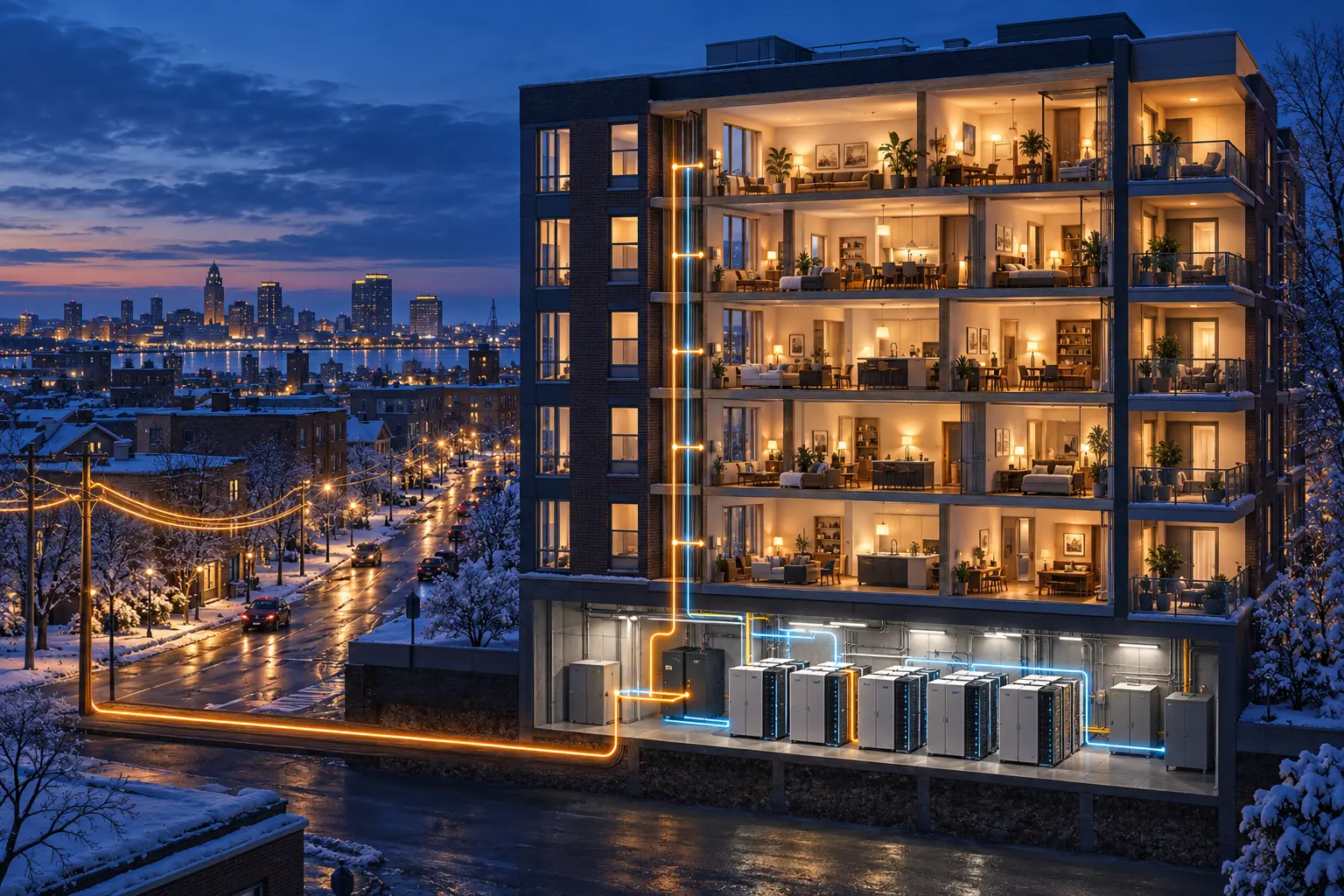
A power plant inside the home
At Peace Bridge Place, a 105-unit affordable housing complex in Buffalo, New York, the energy transition occupies seven rooms inside the building. A 3.75-megawatt-hour lithium-ion battery stores electricity when available and returns it when the grid is strained or prices rise. Viridi and Good Carbon say it can power the complex for several days during an outage. That is a project goal, not yet a publicly measured result from a real blackout.
The novelty is not simply placing a battery beside apartments. Smaller systems already accompany home solar installations, while large ones operate near renewable plants. Here commercial-scale capacity enters an occupied building and does two jobs: protecting homes and helping the grid. If the test works, the building stops being only an electricity customer and becomes a resource that can choose when to absorb energy and when to ease its burden on the system.
How the building earns when it does not consume
Operation begins during less strained hours. The battery charges when electricity is more abundant; in Buffalo that can include hydropower generated near Niagara Falls. When demand rises, Peace Bridge Place uses stored energy instead of drawing from the grid. Through EnergyHub's platform, it can respond to National Grid signals and reduce or shift consumption when each avoided kilowatt is worth more.
The operator cites two benefits: avoiding some peak-related prices and charges, and receiving utility compensation for not consuming, or returning energy, when the grid needs it. Good Carbon says lower operating costs and new revenue could keep the building affordable and maintained. The claim describes the model; it does not yet show how much bills will fall or what share will reach tenants.
The location is no accident. The all-electric building uses a geothermal system for heating and cooling instead of gas. It therefore needs continuous power even for functions that use separate fuels elsewhere. NYSERDA supported the project through its Future Grid Challenge; National Grid treats it as a test of flexible technologies on its distribution network.
The crucial test is stopping a failure from spreading
Bringing batteries of this size to where people sleep changes the order of questions. Safety comes before capacity. Storage fires have fueled opposition, though the Electric Power Research Institute notes a declining failure rate as installations grow. For Peace Bridge Place, saying the risk is rare is not enough: containment must work when a cell is deliberately pushed to failure.
Viridi says it spent six years and ten million dollars designing the enclosure, destroying batteries in tests. Plates, pouches and spacing separate the cells so, the company says, one failure dissipates energy without spreading. AP reviewed a test account in which a light fabric covering the battery neither charred nor ignited when failure was forced. The system also met Underwriters Laboratories standards that Viridi says permit indoor installation without a new building fire-suppression system.
These results matter, but do not complete verification. A controlled test measures a defined event; daily use adds maintenance, sensors, software, ventilation, human error and aging. Someone must inspect connections, replace modules and recognize abnormal signals. AP documented this work at Viridi's Buffalo factory, where Derek Cheatom inspected units and Paige McNair stacked modules. Safety is a repeated industrial practice, not just a one-time certification.
What changes for people living above the battery
For residents, the clearest benefit is power during an outage. But service quality depends on which loads are maintained, for how long and with what priority. Powering lights, refrigerators, elevators, pumps and heating are different tasks. Sources indicate several days of autonomy without a detailed protocol for each scenario. We still need to know how the operator communicates charge levels and which functions remain active when power truly fails.
Savings also require transparency. If the battery lowers the building's overall costs, maintenance, investment repayment and tenant rates must be separated. The project is in affordable housing and publicly supported to include disadvantaged communities in the transition. That purpose does not automatically guarantee lower bills. How benefits are distributed will matter more than device performance alone.
There is also a matter of trust. Residents accept a technology many communities prefer to keep at a distance. The operator must make certifications, emergency plans and responsibilities understandable, without turning residents into spectators of a technical demonstration. A resilient system needs information and procedures as clear as its enclosures are strong.
From an inhabited prototype to replicable infrastructure
Peace Bridge Place reveals a broader transformation. As more heating, transport and services run on electricity, the grid must serve higher peaks. Reinforcing cables and substations remains necessary, but buildings can also learn to shift demand. An apartment battery buys time: it stores energy when the system can breathe and uses it when crowded. Avoiding a draw at the critical moment can benefit everyone, not only the system's owner.
Replication will depend on figures the launch does not provide: total cost, module life, capacity loss, maintenance expense, grid revenue and behavior during long outages. These data must be compared with generators, grid upgrades or smaller distributed batteries. Space matters too: not every building has seven service rooms or can adapt them without taking space from other uses.
The most convincing evidence will come after the announcement. If tenants get through a blackout with essential services running, if costs are published and modules remain safe as they age, the battery could become a model. Until then, Peace Bridge Place is more useful than a promise and less definitive than a solution: installed infrastructure that finally lets us measure what happens when the grid enters an apartment building and the building starts working for the grid.