 Italiano
 English
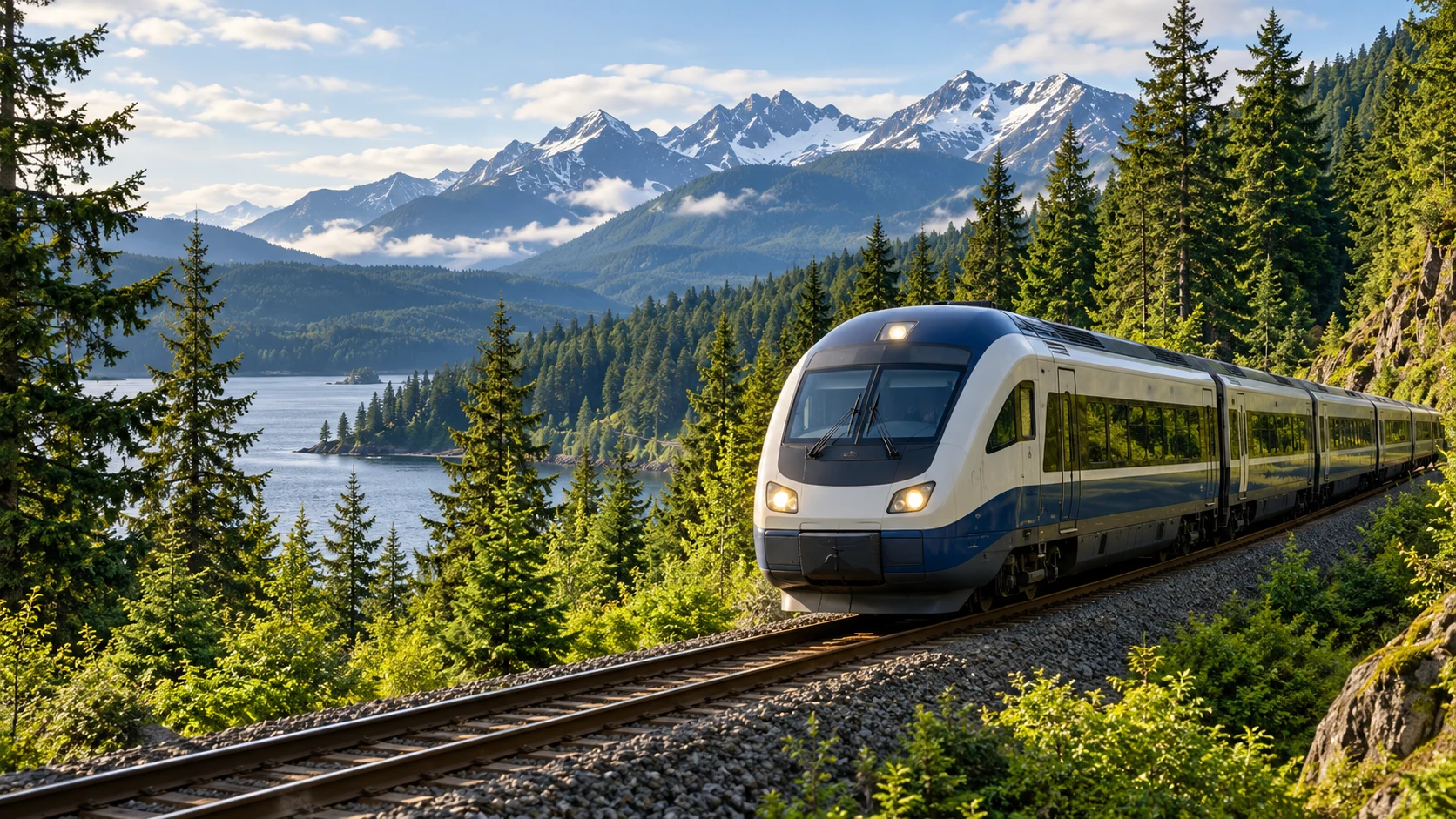
The debut is on a cross-border route
On September 30, 2026, the first Amtrak Airo trains began carrying passengers on the Cascades, the corridor linking Vancouver in the Canadian province of British Columbia with Seattle, Portland and Eugene in the United States. This is the national debut of Amtrak's new family of trainsets, not merely a prototype unveiled at a station. For someone deciding how to travel across the Pacific Northwest, the practical question is whether a more comfortable train can change a journey currently weighed against driving and flying.
The answer cannot be read from the bodywork alone. Amtrak says two new trainsets are now in service and cover four daily trips in the corridor. That does not mean every Cascades departure already uses Airo, nor that four extra services have been added: the figure describes the initial deployment of the new equipment. According to the announced schedule, six more trains for this line should arrive by early 2027. The first phase is therefore more a test in ordinary traffic than an immediate replacement of the entire fleet.
What changes on board, and what does not
The new configuration provides more than 300 seats per trainset. Amtrak lists seats with more legroom, power outlets and USB-C ports, Wi-Fi, large windows and accessibility features. These matter on a journey lasting several hours: passengers can work, read or simply cross the landscape without driving. The company also presents greater energy efficiency and better reliability as goals of the program. Reliability, however, has to be measured over repeated service; an inauguration cannot show that delays will fall.
For a passenger, the vehicle is only part of the experience. A seat on the desired departure, the ticket price, the time needed to reach the station and actual punctuality may matter more than the interior design. In the documents we consulted, we found no independent measurement after launch comparing delays, fares or passenger satisfaction between the new trains and their predecessors. It would be wrong to attribute a verified increase in ridership or a victory over driving to the debut already. The test starts now.
An itinerary across cities and borders
The Cascades is interesting because it serves more than one pair of metropolitan areas. It calls at major cities and smaller communities across Washington and Oregon, and crosses the Canadian border. A visitor might plan a trip with several stops; an occasional commuter might seek an alternative to highway traffic; an international passenger must also account for documents and border crossing time. These are possible uses, not a statistical description of the Airo passengers who have already boarded. The corridor's promise is to connect different places through a useful sequence of stops without requiring a rental car at every stage.
This geography calls for care in comparisons. A city-centre-to-city-centre train journey cannot fairly be compared with the flight time between two airports alone. Access, screening, waiting, transfers and the final leg must be included; the same applies to a car, with parking and traffic conditions. The outcome changes by route and day. Environmental benefits also depend on occupancy, energy and the alternative trip avoided: a photograph of a new train is not a calculation of emissions for an individual journey.
For a family planning a trip, there is another practical detail: knowing in advance whether the ticket is for the new trainset. Amtrak encourages travellers to look for the new-train designation while booking. With only two sets in the initial phase, anyone who wants to try Airo should check the specific departure instead of assuming all trains on the route are identical. The distinction also guards against disappointed expectations. An announcement about an entire line can make an amenity available on only some departures seem universal. As the other trains arrive, this difference may narrow; the announced delivery pace does not guarantee a date for each service.
The investment does not end at delivery
Airo trains are built by Siemens Mobility in the United States. Amtrak links production to suppliers in 31 states; that is a company-reported figure useful for understanding the industrial scale of the program, not a measure of the net economic benefit for each area. The company plans to introduce this train family on other routes too, with Northeast Regional service indicated for late 2027. This is an announced timetable, subject to production, testing and operational decisions, not a service available to book today.
A new trainset needs maintenance, staff training, spare parts and coordination with corridor operators. If the goal is to persuade more people to take the train, competitive timetables and easy connections with local transport matter as well. Commercial potential comes from the combination of frequency, reliability and ease of use, not from adding a USB-C port. That is our assessment, not a forecast of Amtrak's revenue. The available announcements do not allow us to isolate how much the two new trains will increase demand on the Cascades.
The difference between announcement and service
Today's verifiable point is precise: the trainsets began carrying passengers on September 30; Amtrak and two trade and local news outlets report the debut. The list of amenities and future deliveries, by contrast, comes mainly from Amtrak. Travellers' assessment needs a different timeline: weeks and months of runs, not the day of the ribbon cutting. This is the distinction between an event that has happened, an operator's statement and a hypothesis about its effects.
A useful test would track how many services Airo actually operates, their punctuality and seat availability across seasons. It would then ask travellers whether the onboard improvement really affects their choice compared with other modes. Counting ordered trains is not enough to conclude that a region has solved its mobility problems: infrastructure, the border and the network of connections remain part of the same experience.
For now, the journey has gained a new protagonist. It is a tangible change for those who find one of the departures operated by the first two trainsets, and a sign of investment in a connection across cities, states and a national border. The most interesting question is not whether the train looks good, but whether choosing the Cascades will be easier and more predictable a year from now. The debut opens that test; it does not close it.